


Study Table Ideas for a Small Common Bedroom in Singapore
In many Singapore homes the common bedroom has to do two jobs. It is where a child sleeps and does homework, where a young adult works from home, or where a guest bed shares space with a laptop and a pile of files. Once the bed and wardrobe are in, the study table usually gets whatever wall is left.
That leftover wall is often next to the window, behind the door or beside the aircon unit, and the wrong desk makes the whole room feel tight. This guide covers how to pick a study table for a small common bedroom in an HDB flat, BTO or condo: which size to measure for, where to place it, which desk style suits which layout, and how to keep the set-up comfortable for long hours.

Quick answer: which study table suits a small common bedroom?
For laptop work, a desk about 100cm to 120cm long and 45cm to 50cm deep usually fits a small common bedroom. If you use a monitor, allow more depth so the screen can sit 50cm or more from your eyes. Leave about 90cm behind the chair, place the desk side-on to the window, and consider floating, corner or bed-and-desk designs where floor space is tight.
How much space does a study corner really need?
A study corner needs more room than the desk's footprint. You also need space for the chair to slide back and for someone to walk past it. One office-furniture planning guide gives about 36 inches (roughly 90cm) behind a seated user as the minimum, with 42 to 48 inches (about 107cm to 122cm) for comfortable daily use. In a small bedroom, 90cm is a sensible working target.
A quick measuring checklist
- Measure the free wall length, stopping short of the door swing, wardrobe doors, power points and aircon trunking.
- Measure from that wall to the bed or wardrobe opposite. Subtract about 90cm for the chair. What remains is your maximum desk depth.
- Check the window: note the sill height and whether a window grille or ledge projects into the room.
- Mark where sockets sit, so cables from a lamp, laptop or monitor do not have to cross a walkway.
- Note how wardrobe doors and drawers open. A desk chair should not block them.
What desk height and depth should you look for?
Most standard desks are about 72cm to 76cm high (28.5 to 30 inches), which suits many adults when paired with an adjustable chair. Depth is where small rooms differ. A 40cm to 45cm-deep desk is comfortable for a laptop and notebook. If you add a separate monitor, ergonomic guidance from the US Occupational Safety and Health Administration (OSHA) suggests a viewing distance of about 50cm to 100cm, so a deeper desk or a monitor arm becomes more useful.
Where should you place a study table in a small bedroom?
Placement matters as much as size. OSHA's computer workstation guidance recommends placing the monitor perpendicular to the window, which reduces glare on the screen and avoids sitting with bright sky directly behind it. In practice, that means setting the desk side-on to the window rather than facing it or with your back to it.
- Side-on to the window: natural light falls across the desk and you can still look outside during breaks.
- Against the wall at the foot of the bed: often the longest clear wall, and it keeps the study zone visually separate from the bed.
- Into a corner: an L-shaped desk turns an awkward corner into a full workspace and leaves the middle of the room open.
- Not behind the door: a chair that collides with the door every time someone enters will quickly become a problem.
Keep the top of the screen at or slightly below eye level, as OSHA recommends. A laptop stand with a separate keyboard is a simple way to do this on a shallow desk.

Which study table style works best for your layout?
There is no single best design. The right one depends on which wall you have and how the room is used.
| Desk style | Best for | Things to check |
|---|---|---|
| Floating (wall-mounted) | Very small rooms where clear floor space matters | Needs a solid wall and proper fixings; height is set at installation |
| Slim desk on legs | Laptop work and homework along a short wall | Shallow depth leaves less room for a monitor |
| Corner or L-shaped | Rooms with a free corner and two short walls | Measure both returns; tall shelving can make a room feel narrower |
| Bed with built-in desk | Children's rooms and compact rooms needing storage | A single combined piece; check the bed size and desk depth together |
| Height-adjustable | Long work-from-home days and rooms shared by people of different heights | Needs a nearby power point; check the full height range |
Should the study table share a wall with the bed?
It can, but keep at least a chair's width clear between the desk edge and the bed so you are not squeezing past. If the room is shared, a desk at the foot of the bed often works better than one at the bedside, which tends to collect night-time clutter. Our guide to lift-up and drawer storage beds explains how bed storage affects the clearance you need on each side.
How can you keep a small study corner organised?
A small desk stays useful only if the surface stays clear. Plan storage before you buy the table.
- Go vertical. Wall shelves, a pegboard or a narrow bookshelf above or beside the desk keep books and stationery off the work surface.
- Give cables a route. Run cables along the back edge with clips or a tray, and keep the extension cord off the floor where a chair can roll over it.
- Use drawers for school or office paperwork. A small mobile drawer unit can slide under the desk and move out when needed.
- Light the desk separately. A desk lamp placed on the side opposite your writing hand reduces shadows on the page.
- Mind the humidity. Keep paper and books off the window ledge, where rain blown in through an open window can reach them, and store them in closed drawers during wetter months.

Urban Mood study tables for small bedrooms
These five come from our study tables and work desks collection, chosen to cover different layouts.
TIMON Scandinavian Floating Study Table is made from New Zealand pine wood with visible knots and grain. The top is 50cm deep and 5cm thick, in lengths from 120cm to 260cm, and there is an option with three matching floating shelves. Because it mounts to the wall, it suits a very small common bedroom where you want the floor clear for a mobile drawer or a storage box. Confirm your wall type before ordering a wall-mounted piece.
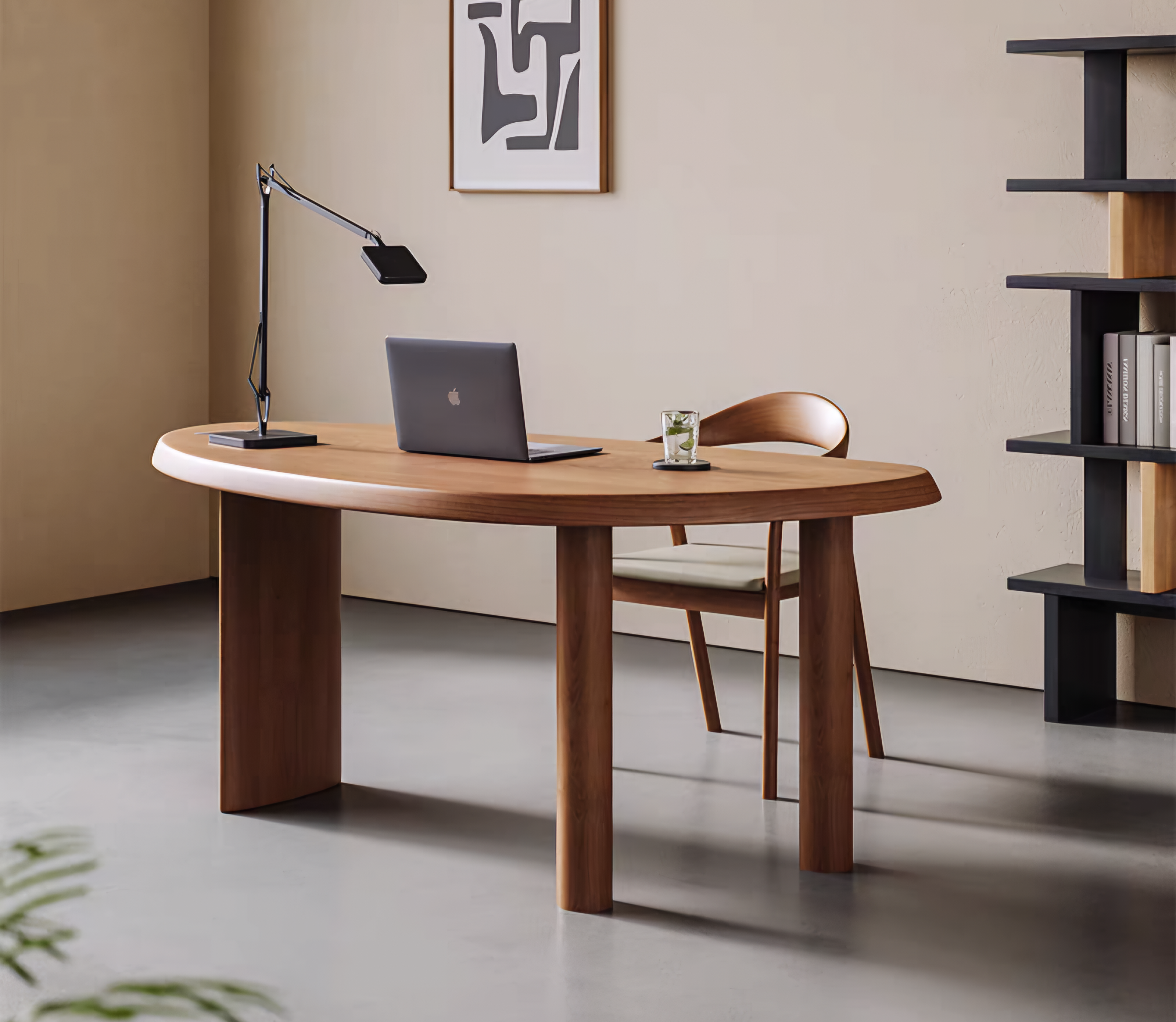
LEANNA Modern Industrial Solid Wood Slim Study Table has a solid wood top on powder-coated steel hairpin legs. It is 45cm deep and 75cm high, in 100cm, 120cm and 140cm lengths, with Natural Oak, Golden Walnut or Dark Walnut tops and Black, White or Gold frames. The slim depth makes it a good fit for laptop work along a short wall or under a window ledge.

SEGHERS Modern Solid Wood Corner Study Table is made from pine wood with a powder-coated iron frame, and its angular shape is designed for compact rooms. It includes an integrated shelf and pegboard, and comes in a range of L-shaped sizes from 120/80cm up to 220/120cm, all 55cm deep and 175cm high including the shelving. It suits a room with a free corner and someone who needs space for books and study materials.
FOUNDRY Modern Storage Bedframe & Study Table brings the bed, study table, storage and shelving together. The raised bedframe has storage beneath, with drawers along the study table and steps. It comes in Single, Super Single, Queen and King, and the study table measures 100cm long, 40cm deep and 75cm high. It is made from E1 high-density fibreboard. This works well in a child's room, and you can browse more space-saving options in our storage beds collection.
LANDING Modern Adjustable Study Table adjusts between 71cm and 117cm for sitting or standing, with an LED height display and memory control for four height settings. It is made from laminated plywood with a powder-coated iron frame, 60cm deep, in 100cm, 120cm and 140cm lengths and five colours. The extra depth suits a monitor, and the memory settings help when siblings or a parent and child share one desk.
Frequently asked questions
What is a good study table size for a small HDB bedroom?
For most small common bedrooms, a desk about 100cm to 120cm long and 45cm to 50cm deep works well for laptop use. Choose 60cm or more if you work with a separate monitor.
Can I put a study table in front of the window?
You can, but you may get glare and bright light behind your screen. Placing the desk side-on to the window, so the monitor is perpendicular to it, is usually more comfortable.
How much space do I need behind a study chair?
Aim for about 90cm between the desk edge and the nearest obstacle, such as a bed or wardrobe. This lets you push the chair back and stand up without squeezing past.
Is a floating desk a good idea in a small room?
Yes, if you have a solid wall and suitable fixings. A floating desk keeps the floor clear, which makes the room feel larger, but its height cannot be changed once installed.
What is the best study table for a child's common bedroom?
A bed with a built-in desk or a slim desk with wall shelves both work well. Pair either with an adjustable chair so the set-up can grow with your child.
Planning your study corner
Start with the clearance behind the chair, then choose a desk depth that suits how you work: shallow for laptops, deeper for monitors. Place the desk side-on to the window, plan vertical storage early and pick a style that matches your free wall, whether that is a floating desk, a corner unit or a bed-and-desk combination. If the common bedroom opens onto a compact living area, our 3-room BTO living and dining guide uses the same measure-first approach. When you are ready, browse our full range of study tables and bedroom furniture to plan the room as a whole.